Essentially a conversation with myself and
anyone else who has come along and joined
in from time to time.
FIRST MUSING: ... When starting to pull one's thoughts together in attempting to make sense of the world you dredge your memories for anything that ever made sense. Quite quickly in Dickens you can discover that the opening paragraph in his 'Tale of Two Cities' (1859) that still resonates in the here and the now ... "It was the best of times, it was the worst of times, it was the age of wisdom, it was the age of foolishness, it was the epoch of belief, it was the epoch of incredulity, it was the season of Light, it was the season of Darkness, it was the spring of hope, it was the winter of despair, we had everything before us, we ...."
Watch the news on TV and Dickens' opening resonates loudly in 2024 with dystopia raining down upon people in far away places and in ways that should give everyone cause to reconsider their relative comfortableness and then there is the spectre of Climate Change. Then there is that cliche that goes 'it is what it is'.
Then one comes to the crux of 'placedness'. Places shape culture; it's sensitivities a sensibilities; and cultures shape places. Wilderness in the end is a cultural imagining [Link] and as it has turned out, so too was Terra Nulius [ Link] and its an imagining that still lurks in some AUSTRALIANmindsets.
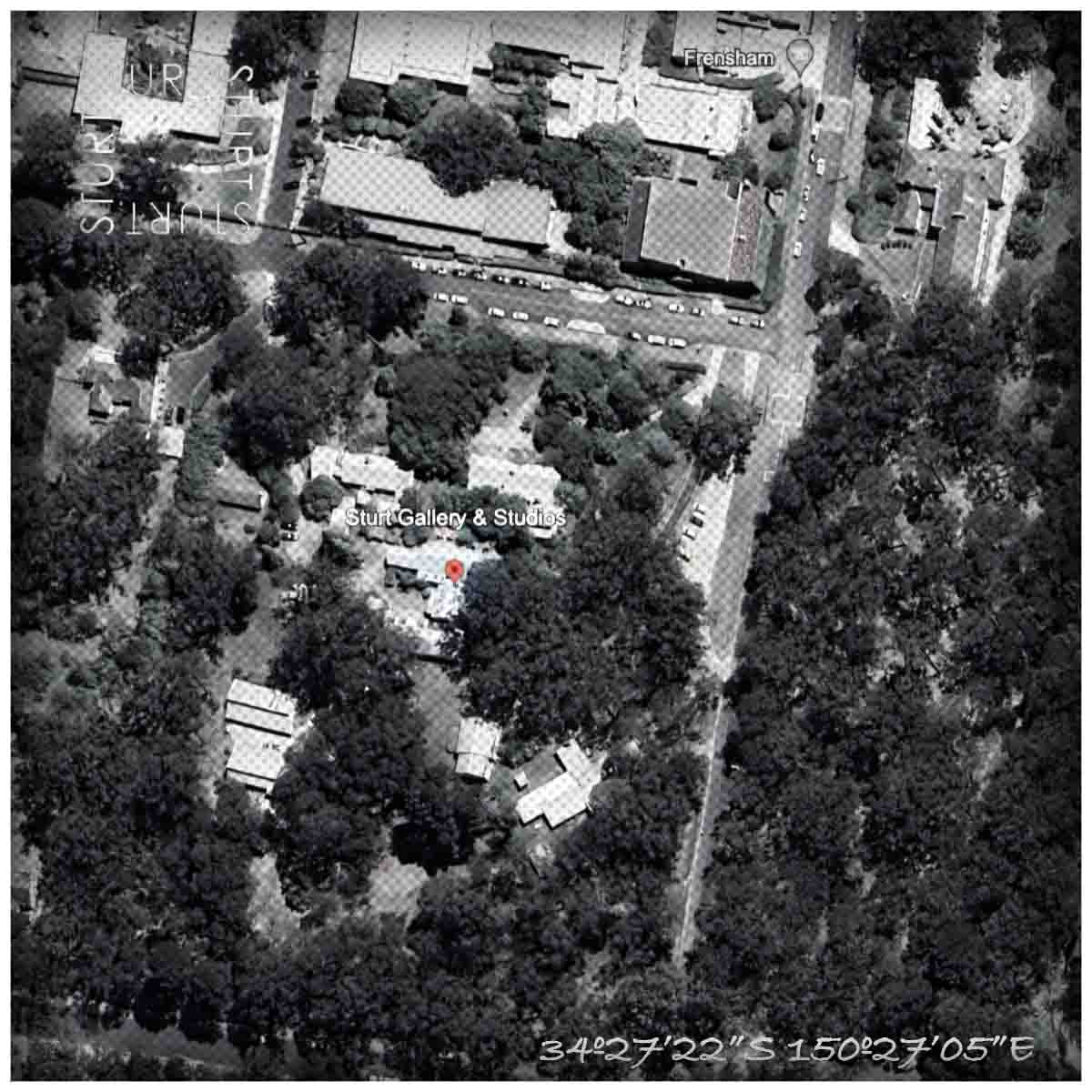
Culturally and geographically, in Mittagong, Sturt's 'placedness' is in one sense a cultural imagining. Winifred West's planting of what might be imagined as a 'cultural flag' in amongst all the dystopia raining down upon the world in 1941 is worth a thought. It is something that resonate still. The cultural 'wilderness' ... wilderness for the lack of a better word ... was there and all around her. Suffice to say, she got about experimenting [Link] in the space that surrounded her in 1941 and she came to it with a mind to make her Sturt 'a place' where change could be imagined. It turns out that she was a quintessential PLACEmaker. And, fundamentally Winifred West was a 'maker'!
After all that, then comes the WORDstruggle as 'spoken' language and 'visual' language need to find resonances in each other and in ways that make sense relative to 'making's' haptic experiences. If we imagine 'object makers' as having, fundamentally, an audience of 'just one' it soon puts them at odds with the status quo relative to marketing in many cultural landscapes. Again, it is what it is.
Against this backdrop how does one interrogate 'making' and 'utopia'? Should it be 'utopia and making' or 'utopia's making' or what? Well it turns out to be an open question in the here and now. Yet in indigenous CULTURALrealities there is a growing sense of awareness that this is a matters that has been well understood for eons.
And, then there is a Croatian proverb that goes "We are all born knowing nothing, we all go on trying to acquire wisdom, yet we all die idiots knowing nothing". Again, it is what it is.
PLACEmaking ... Thinking about STURTmittagong as a 'made place' in a CULTURALlandscape, metaphorically at least, it was made in a space rendered vacant by fire. It's a place made to facilitate 'making' in a CULTURALlandscape, that in 1941 existed in a dystopian world caught up in a raging world conflict albeit that the military action was going on far away. Nonetheless, that action was having an impact very close to home almost everywhere in Australia. In Mittagong, and elsewhere, people at the time were finishing their education very young and with large gaps in the preparation for the life that lay ahead.
Post WW2 the Western World changed systematically with the background aspiration being to create wealth in the wake of war. The consequent industrialisation of manufacture led to the rise of industrial design, a resurgence of mass production, and a prototypical mindset that all too often led to a dependance upon 'planned obsolescence' [Link]. Arguably, this might well be imagined as ia somewhat dystopic CULTURALlandscape.
Nonetheless, memories of the 'Arts and Crafts Movement' [Link] post the European Industrial Revolution had not faded albeit that the movement had its critics.
Winifred West never lived in an intellectual desert or in isolation and without all that much doubt she would, at least subliminally, have been aware of Robert Ashbee's [Link] Chipping Campden 'experiment' [Link-item6] in the Cotswolds that in one sense faltered but in another lives on to this day.
However, CULTURALlandscaping in Mittagong and Australia wide has evolved and changed over time but the need for 'makers' who have audiences of ONE and ONEother is unlikely to fade. Looking for an exemplar, a 'wedding ring maker' offers a poignant example in a cultural context. What is it that a bespoken wedding ring might have that might separate it from a mass produced one purchased from almost any shop anywhere – albeit that both might look pretty much the same. The 'shop bought ring' after the wedding ceremony becomes loaded with meaning that needs no explanation. Whereas, a bespoke ring that is made without a join and 'made' with the gold of various family rings that come together in a alloy that might be of a mysterious GOLDpurity goes to the wedding ceremony loaded with meaning known only to those being wed – albeit that the bespoke ring might well look pretty much the same as the shop bought ring.
Looking elsewhere with 'the taking of tea' in mind, a STOREbought mass produced cup and a TEAmaster's 'Chawan' the differences are stark. The china tea cup is branded, replaceable but durable and marketed as being serviceable. However, Hamada's chawan comes as an exemplar of the mingei – folk-art – movement, and almost anonymous and arguably is irreplaceable. The two 'vessels' are hardly equivalent, yet both hold tea. Their 'placedness' in a CULTURALlandscape divides them. That a MAKINGplace came to be in Mittagong, STURTmittagong has become an exemplar 'place' that has been emulated elsewhere and for the most part serendipitously .
Arguably, bespoke wedding rings and mingei chawans have two things in common:
- Their investment in their audience of ONE and ONEother; and
- The CULTURALlandscapes they evolved within.
In every CULTURALlandscape there are needs for things that hold and tell stories for that audience of ONE and ONEother. The making of things and places are intrinsically bound together across all CULTURALrealities. It is deeply embedded in our humanity and it finds expression in our 'placedness'. Indeed we celebrate all this and we might well do so more overtly .
 |
NOTES - The submission has been divided into 9 PARTS under various headings above; and
- The heading 'THE LONG READ' brings together the 9 PARTS; and
- There are GLEANEDreferences compiled on the sturt stuff site CLICK HERE and additional references are indicated above: and
- zingTEXT is used throughout the submission and the protocols are explained under the heading above; and
- A HARDCOPY publication is in prospect; and
- The conversationalist who have contributed to the development and articulation of information and concepts are acknowledged and they know who they are.
“For if you suffer your people to be ill-educated, and their manners to be corrupted from their infancy, and then punish them for those crimes to which their first education disposed them, what else is to be concluded from this, but that you first make thieves and then punish them.” ..... Sir Thomas More, Utopia
"We are verbs and never nouns"
Stephen Fry
|